



Parasite
Antiparasitics are a class of medications which are indicated for the treatment of parasitic diseases such as nematodes, cestodes, trematodes, and infectious protozoa.
Parasite Isoform Specific Products
All Product Categories
-
Parasite Related Products (2548)
Related Products (2548)

-
Related Compound Screening Libraries (1)
-
Parasite Isoform Comparison
-
Asparagusic acid (Standard)
 0 ImagesAsparagusic acid (Standard) is the analytical standard of Asparagusic acid. This product is intended for research and analytical applications. Asparagusic acid is a sulfur-containing flavor component produced by Asparagus officinalis Linn., with anti-parasitic effect. Asparagusic acid is a plant growth inhibitor.
-
Carnidazole (Standard)
 0 ImagesCat. No.: HY-119900RCAS No.: 42116-76-7Carnidazole (Standard) is the analytical standard of Carnidazole. This product is intended for research and analytical applications. Carnidazole is an antiprotozoal agent of the nitroimidazole class. Carnidazole is used for the research of Trichomonas infection.
-
Dieugenol
 0 ImagesDieugenol is a neolignan that has been found in N. leucantha and has antioxidative and antiprotozoal activities. It inhibits the formation of thiobarbituric acid reactive substances (TBARS) and scavenges superoxide anions, but not hydroxyl radicals, in cell-free assays. It has anti-trypanosomal activity against T. cruzi amastigotes and trypomastigotes (IC50s=15.1 and 11.5 μM, respectively) but is cytotoxic to NCTC L-929 fibroblasts with a 50% cytotoxic concentration (CC50) value of 58.2 μM.2 Dieugenol (15 μM) disrupts the integrity of the T. cruzi trypomastigote plasma membrane but does not induce the production of reactive oxygen species (ROS) in trypomastigotes or LPS-stimulated and unstimulated isolated mouse peritoneal macrophages.
-
Bitipazone
 0 ImagesCat. No.: HY-162572CAS No.: 13456-08-1Bitipazone, diacetylbis(piperidinethyl)thiourea cysteine ester (I), has potent anticoccidial activity. Bitipazone showed significant efficacy and good tolerability in rabbits and turkeys, and in chronic toxicity tests, bitipazone was tolerated in turkeys at concentrations below 90 ppm in feed. Pharmacokinetic studies show that bitipazone is eliminated slowly from the blood and organs of these animal species.
-
Hydroxychloroquine O-sulfate sodium
 0 ImagesCat. No.: HY-W654221CAS No.: 2740402-74-6Synonyms: HCQ O-Sulfate sodiumHydroxychloroquine O-Sulfate (HCQ O-Sulfate) sodium is a derivative of the antimalarial agent Hydroxychloroquine (HY-W031727).
-
Desferriferrithiocin
 0 ImagesCat. No.: HY-16913CAS No.: 76045-30-2Synonyms: CGP 23841ADesferriferrithiocin (CGP 23841A), a microbial iron chelator, inhibits the growth of P. falciparum in a dose dependent way.
-
AB3127-C
 0 ImagesCat. No.: HY-120316CAS No.: 139159-01-6AB3127-C is an anti-mite agent that can be isolated from Streptomyces platensis AB3217. AB3127-C exerts a protection coefficient of 90% at a concentration of 100 μg/mL.
-
Desethyl chloroquine (Standard)
 0 ImagesCat. No.: HY-135811RCAS No.: 1476-52-4Desethyl chloroquine (Standard) is the analytical standard of Desethyl chloroquine. This product is intended for research and analytical applications. Desethyl chloroquine is a major desethyl metabolite of Chloroquine. Chloroquine diphosphate is an inhibitor of autophagy and toll-like receptors (TLRs). Desethyl chloroquine possesses antiplasmodic activity.
-
Antimalarial agent 55
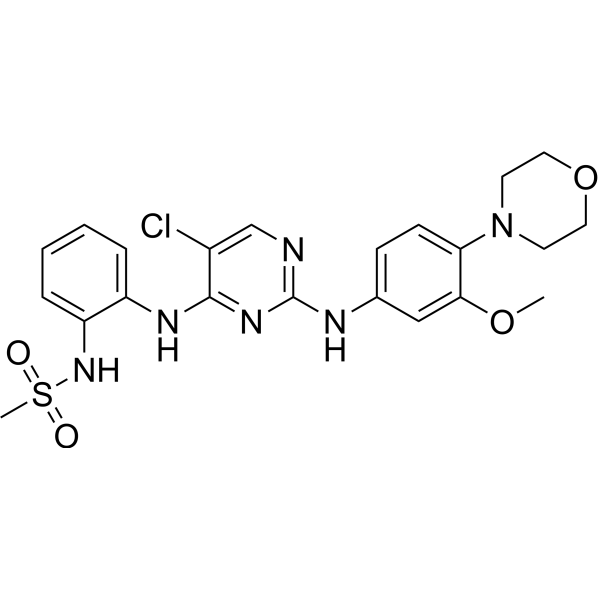
 0 ImagesCat. No.: HY-181266Antimalarial agent 55 is an orally potent inhibitor of PfA-M1 and PfA-M17 aminopeptidases from Plasmodium falciparum, with Ki values of 27 nM and 81 nM, respectively. Antimalarial agent 55 exhibits potent nanomolar activity against homologous enzymes from Plasmodium vivax and Plasmodium berghei, with Ki values of 2 nM, 4 nM, 190 nM and 18 nM for Pv-M1, Pb-M1, Pv-M17 and Pb-M17, respectively. Antimalarial agent 55 possesses significant antiplasmodial activity, as well as cross-species inhibitory capacity and broad-spectrum activity that is unaffected by existing drug resistance mechanisms. Antimalarial agent 55 can be used in malaria research.
-
Naringenin trimethyl ether
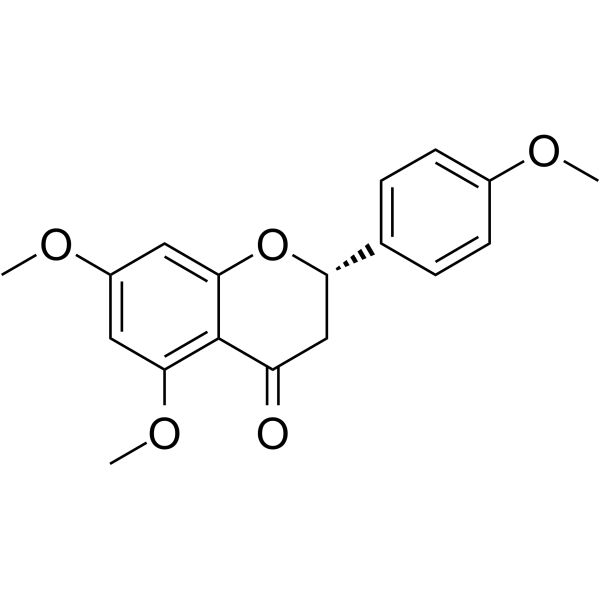 0 ImagesNaringenin trimethyl ether is a constituent of twigs and leaves of Aglaia duperreana. Naringenin trimethyl exhibits significant molluscicidal activity, with a LC50 of 3.9 μg/ mL for P. canaliculata.
-
5-Fluoroorotic acid (Standard)
 0 Images5-Fluoroorotic acid is the inhibitor for thymidylate synthase that acts as a selective agent in yeast molecular genetics. 5-Fluoroorotic acid exhibits antimalarial activity.
-
DDD00057570
 0 ImagesDDD00057570 is a selective M17 leucyl-aminopeptidase (LAP) inhibitor. DDD00057570 inhibits L. major and L. donovani intracellular amastigotes in vitro growth.
-
Arterolane maleate
 0 ImagesCat. No.: HY-10852ACAS No.: 959520-73-1Synonyms: OZ 277 maleate; RBx 11160 maleateArterolane (OZ 277) (maleate) is an orally active antimalarial. Arterolane exhibits potent activity against erythrocytic stages of P. falciparum and Plasmodium vivax. Arterolane (maleate) is promising for research of falciparum malaria.
-
Chlorphenoxamine (Standard)
 0 ImagesChlorphenoxamine (Standard) is the analytical standard of Chlorphenoxamine (HY-B1607). This product is intended for research and analytical applications. Chlorphenoxamine, an antihistamine and anticholinergic agent is a GPCR antagonist. Chlorphenoxamine inhibits multiple lethal viral diseases, such as SARS-CoV, MERS-CoV, EBOV and malaria. Chlorphenoxamine shows anti-filovirus activity against both EBOV and Marburg virus (MARV) with IC50s of 1.1 μM and 6.2 μM, respectively. Chlorphenoxamine is used for allergic conditions, urticaria, viral diseases and Parkinson’s disease.
-
Albendazole sulfone (Standard)
 0 ImagesCat. No.: HY-W019773RCAS No.: 75184-71-3Albendazole sulfone (Standard) is the analytical standard of Albendazole sulfone. This product is intended for research and analytical applications. Albendazole sulfone is a metabolite of Albendazole, and exhibits anti-parasite effect against Echinococcus multilocularis Metacestodes.

-
Fenchlorphos (Standard)
 0 ImagesFenchlorphos (Standard) is the analytical standard of Fenchlorphos. This product is intended for research and analytical applications. Fenchlorphos, an organophosphate, is an insecticide. Fenchlorphos is an inhibitor of the enzyme acetylcholinesterase (AChE). Fenchlorphos is able to cause mitochondrial dysfunction.
-
Abametapir (Standard)
 0 ImagesAbametapir (Standard) is the analytical standard of Abametapir. This product is intended for research and analytical applications. Abametapir is a metalloproteinase (MMP) inhibitor which is able to target metalloproteinases critical to egg hatching and louse development. Abametapir can inhibit hatching of both head and body louse.



